
First ever recording of a crucial visual structure in the human brain
17 December 2025

17 December 2025
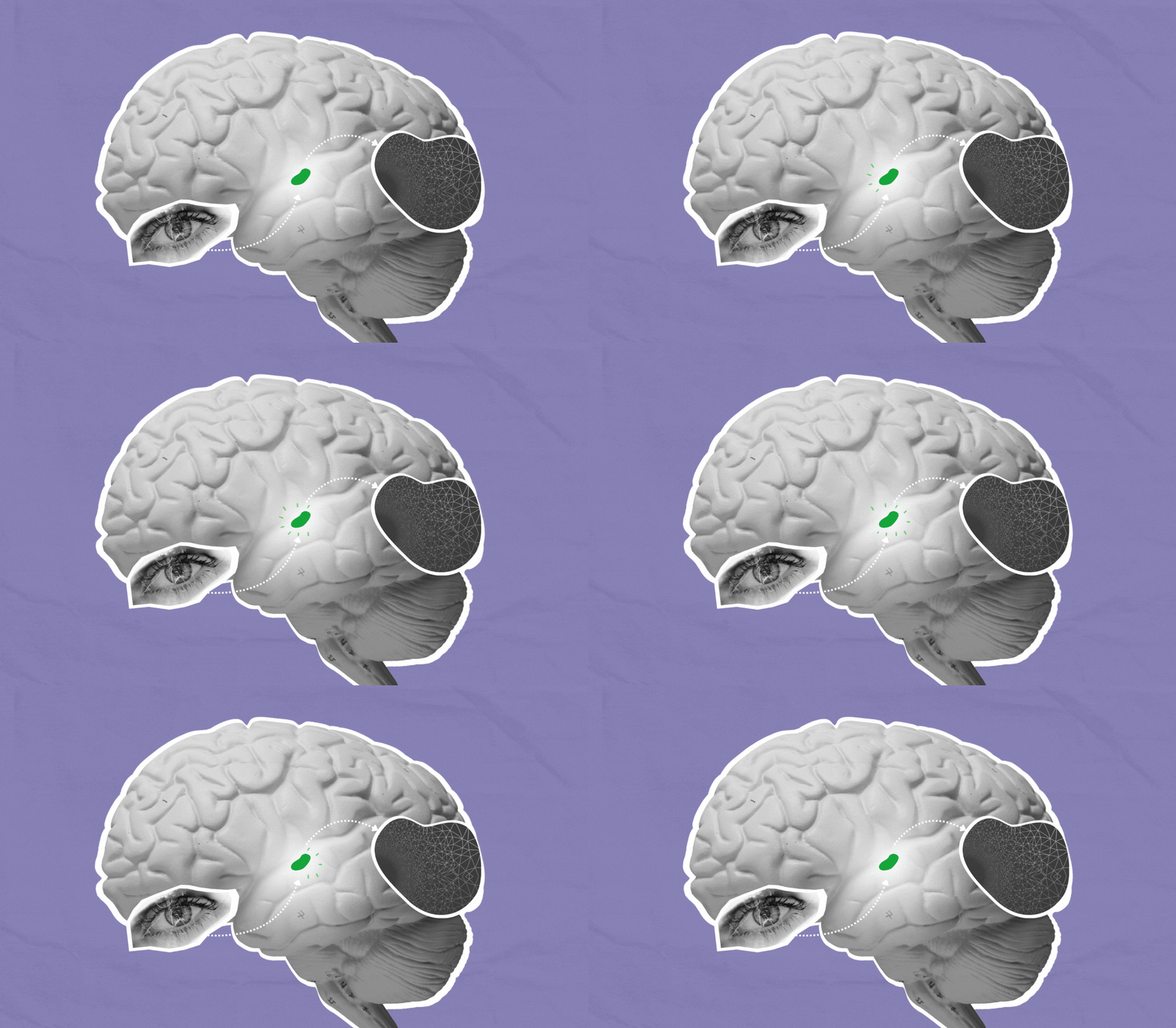 Researchers at the Netherlands Institute for Neuroscience become the first to fully characterize cell activity from a little relay station in the centre of the human brain. This aids our understanding of how the brain processes visual information and will help us develop a visual prosthesis for blind people in future.
The brain’s ability to process visual input may seem like a simple two-step process: your eye receives input from your external environment and the visual cortex in your brain decodes that information.
But neuroscientists are becoming increasingly certain that a little relay station, known as the lateral geniculate nucleus (LGN), is a surprisingly big player in this process. Its role is simple: transferring almost all visual information from the eye to the visual cortex. But as it turns out, this structure does much more than transferring. It actually changes and modulates the signal in the process as well.
“The difficult thing about the LGN is that it has almost always been studied in animals. It is very small, so brain scans can’t give you much information about its structure and workings. Non-invasive measurements also aren’t possible because it’s tucked away so deep in our brain and is therefore impossible to access without invasive procedures”, Matthew Self, first author, explains.
At a colleague’s retirement party, senior author Pieter Roelfsema was presented with a unique opportunity by his ex-colleague, Sergio Neuenschwander. “He just said, oh Pieter, this is great. There’s a neurosurgeon in Brazil who’s going to put an electrode in the LGN. You should come and check it out!”, Self explains.
Receiving a brain implant is still quite unusual but can be used to limit seizures in drug-resistant epileptic patients. In this case, two patients were experiencing seizures that originated in their visual cortex. Targeting the LGN for these seizures is still very new and has likely never been done before.
Not being able to miss this opportunity, Self and Roelfsema flew to Brazil and set up a visual laboratory in the operating room. While the operations were done, they were given 30 minutes to conduct some experiments. The patients were awake and responsive throughout, offering Self and Roelfsema a first glance into the human LGN.
The good news is that their observations largely matched those made in earlier animal studies. Each cell responds to a specific, small circular area of your vision. They’re also often colour tuned (preferring green on red or red on green), and they appear to follow a layered structure that has also been found in animals.
The researchers did however make one striking observation when patients voluntarily closed one eye. “You can’t really ask an animal to do that”, Self adds. Self already knew that LGN cells only responds to vision in one dominant eye. But when the patients closed that eye, some of the cells surprisingly became more active and others less active.
Self thinks this is happening because these cells in the LGN silence the activity of other cells that would otherwise respond to the closed eye. “If you close one eye, you’re blocking half of your visual input. It’s amazing that your perception is pretty much the same. It’s a little flatter, but the colours, luminance, and contrast all remain unchanged”, Self adds.
Perhaps counter-intuitively, observing an increase in activity in the cells that inhibit other cells in the LGN means that there is less overall activity. That way, there is never any signal competition when one of the eyes is closed, and the other eye can just take over.
Researchers in the Roelfsema group are currently working towards a visual prosthesis that could help blind people regain partial vision. This prosthesis would also include an electrode implanted directly into the LGN.
“It’s very validating to know that our findings in animals aligns with our findings in humans. This was only one small experiment of half an hour but we have a huge amount of information from monkeys and from cats. This just shows us that this body of information is correct, that we can use that information to design this prosthesis”.
Source: Nature Communications
The Friends Foundation facilitates groundbreaking brain research. You can help us with that.
Support our work