Steven Sloan: Tracing the Origins of Brain Disorders
2 April 2026

2 April 2026
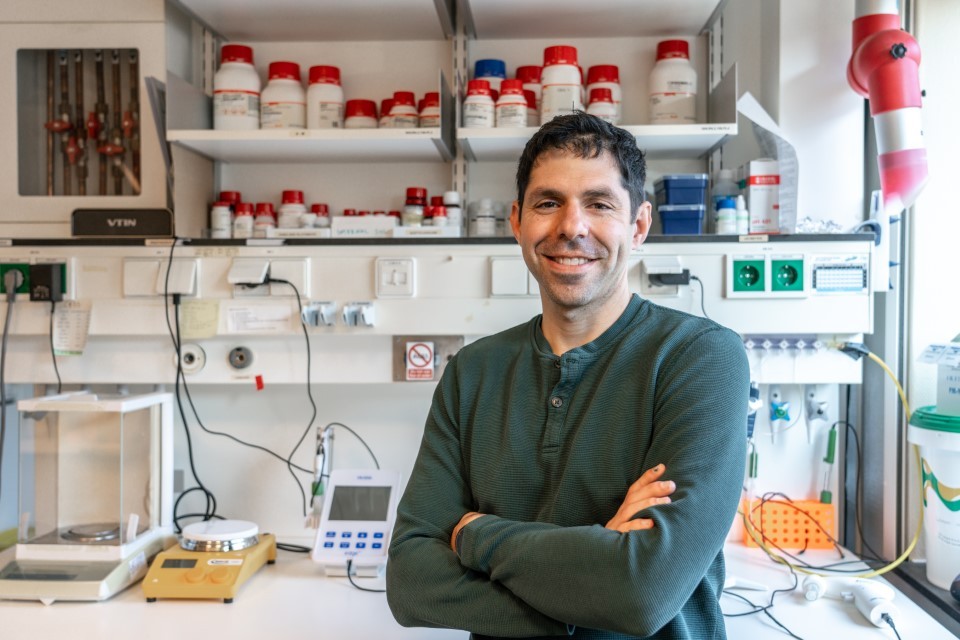
In a freshly-painted room with little to no furniture, Steven Sloan is vigorously typing at his desk in the corner. He has a new publication coming out and is keen to continue his research at the Netherlands Institute for Neuroscience. “There is still a lot of work to be done in this field, and that’s why I think it’s so much fun!”, he chuckles.
Sloan is investigating the developing human brain, a challenging task that was virtually impossible for many decades. This changed thirteen years ago, when researchers discovered how to grow a tiny cluster of cells that resembled a simple version of the human brain.
“These clusters are called organoids, not organs or mini-brains”, he clarifies. “Brain organoids don’t think, they don’t have consciousness, but they do give us the opportunity to watch the early process of human cells growing into a complex tissue”.
Unlike many other neuroscientists, Sloan is exploring astrocytes, these are support cells that are often overlooked. But his exploration has offered valuable insights into developmental conditions, and may continue to do so for a wide array of brain disorders.
The most commonly studied brain cell is the neuron, these are the cells that form a network in the nervous system. Surprisingly, these neurons can only survive when they are accompanied by star-shaped ‘sister cells’ known as astrocytes. “You can imagine astrocytes as the choreographers of the developing brain. If you take them out for a while, the neurons have no idea what to do”.
The importance of astrocytes is not only crucial for Sloan’s understanding of the normal developing brain, but also for many developmental and psychiatric disorders. “They could be the underpinning of autism, schizophrenia or epilepsy”.
Aside from their choreographic role, astrocytes also respond strongly to inflammation. “We call this a reactive state”, Sloan explains, but he can’t say much more than that. “There are probably different types of reactive states depending on the disorder and duration, but we don’t have the words to describe each of those yet, or what the consequences are on disease progression in each setting”.
Sloan has recently published results from his last research group [link to other article], thereby becoming the first to show that astrocytes become reactive during really early stages of development as well. “It’s pretty profound. We think this has implications for why infections during pregnancy can be dangerous and impact the developing brain”.
Sloan will continue his research at the Netherlands Institute for Neuroscience. “I like to convey how interesting neurodevelopment is—that our nervous system isn’t comprised of just one cell type, which already is complicated enough—but that neural development has to be orchestrated by many other cells at just the right time and the right place. We finally have platforms to study that question. That’s what gets me excited.”
The Friends Foundation facilitates groundbreaking brain research. You can help us with that.
Support our work